


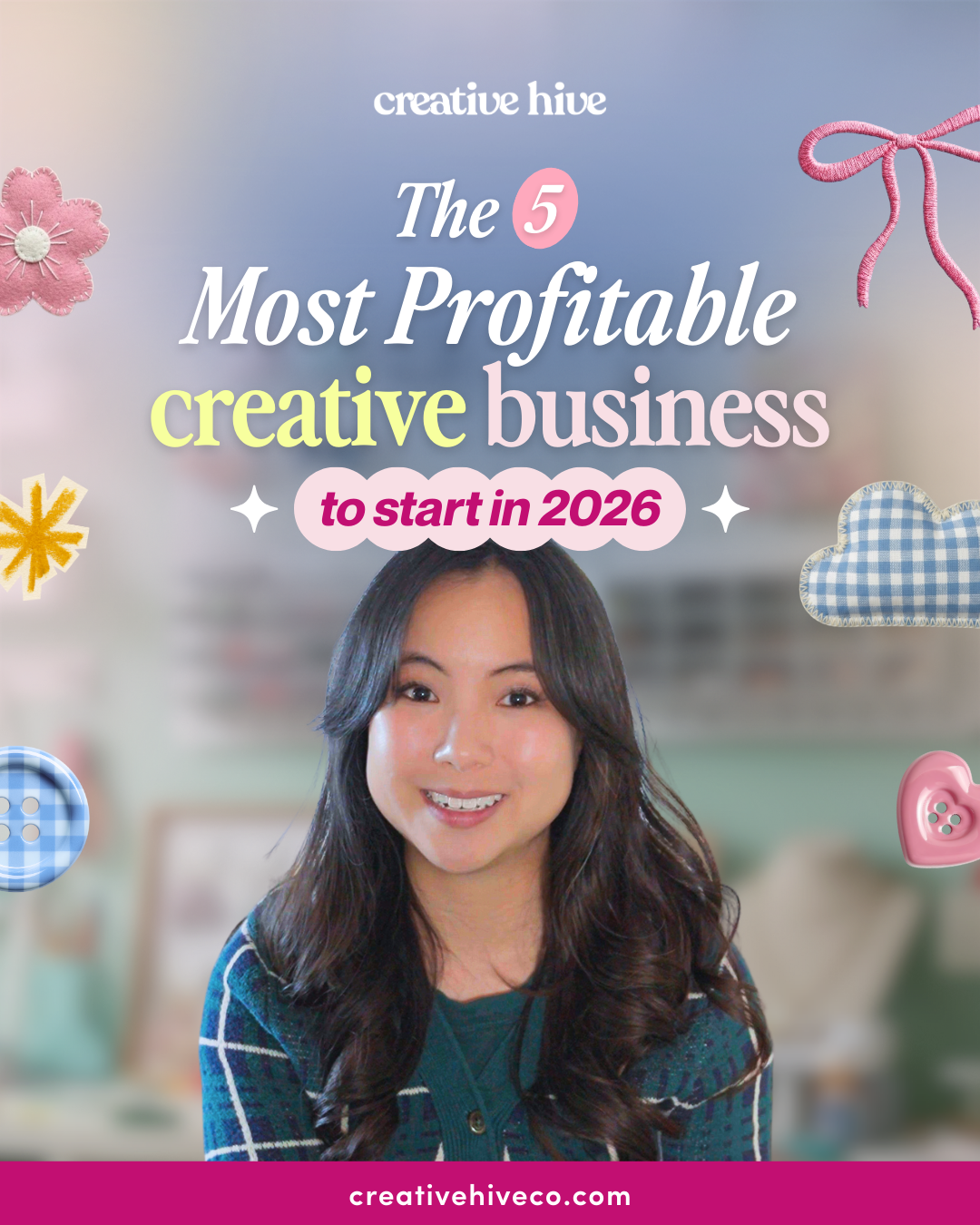
The 5 most profitable creative businesses to start in 2026





The five most profitable creative businesses to start in 2026 aren’t the ones you see blowing up on TikTok or plastered all over Instagram.
They’re not trendy, they’re not oversaturated and they definitely don’t require a massive audience to make money.
But before I share the list, there’s something important you need to understand.
I didn’t choose these ideas randomly or based on what’s popular online. I chose them using clear criteria you can apply to any business idea.
Think: teach a man to fish.
Once you understand how these businesses were chosen, you’ll be able to spot profitable creative ideas on your own.
Products With Recurring Value
When starting a new business, most people worry about the competition.
Is it saturated? Is it too late? Is there still room?
And I get it, people don’t want to waste time or energy on something that won’t work.
But starting there is usually what paralyzes people and that’s not helpful.
Competition is everywhere these days, in every industry. And you’ve probably heard that competition can actually be a good thing, right?
It means your idea is validated and there are already people making money doing what you want to do.
But the first thing I look at isn’t competition, it’s the problem.
What kinds of problems do people have? How can we fix them? What’s annoying people right now?
What’s taking up mental space? What do they wish they didn’t have to think so hard about?
That’s where good business ideas actually start.
So the first type of business I want to talk about is products with recurring value, because this one checks the “problem” box really clearly.
What I mean by that are products people naturally need to buy again and again.
Things like tea, candles, chocolate, dog treats, supplements which is actually something I’m interested in getting into this year.
These aren’t one-and-done purchases, they run out and when they do, people restock without overthinking it.
That’s why these products work so well.
Your customer doesn’t have to re-decide every single time whether they want it, that decision was already made once.
After that, your product quietly shows up in their life again and again, every refill, every reorder, every subscription renewal.
And this matters, because repeat purchases completely change the math of your business.
This is also where you don’t need a massive audience if you get the niche right.
If your product is for everyone, then yes, you’ll need a lot of traffic.
But if you’re speaking to a very specific type of person with a very specific need, you can build a healthy, sustainable business with a much smaller audience.
Pricing matters here too, you don’t need thousands of customers if your pricing actually supports you.
And you don’t need to constantly chase new traffic if the same people keep coming back, right?
For example, if you charge $49 a month and have just 100 customers, you’re already making $4,900 every single month, on repeat!
That’s only 204 customers to hit $10,000 a month, no viral moments required and no constant hustle for new eyeballs.
So how do you take something like recurring products and actually make it work for you?
Here’s the thing, a lot of profitable creative businesses aren’t exciting.
They’re not what’s going to go viral or rack up views on an Instagram Reel and that’s important to understand.
Don’t be fooled by what you see online, and don’t use social proof as evidence of what truly works or what actually pays you an income.
Instead, think about businesses, products, or services that make something easier, faster, more thoughtful, or more personal for someone else. When something genuinely does that, people don’t need to be convinced so much to buy. The value is obvious and the decision feels simple.
If you want a clearer roadmap or some step-by-step guidance on how to actually build something like this, I’ve got a free workshop for you.
Just click here to check it out: https://tinyurl.com/3xvj598r
The second thing I look for is a moat.
I know that word can sound very business-y, but all it really means is this: what makes the business hard to copy?
Taste is hard to copy, process is hard to copy and style and trust are hard to copy.
When your business has something that’s inherently difficult to replicate, it naturally stands out.
And when that happens, you don’t have to obsess over competition because you’re not trying to be interchangeable in the first place.
This is also why having your own home base matters so much.
If you’re building something that’s meant to last, you don’t want everything tied to platforms you don’t control.
One of the first things I personally do whenever I’m creating a new business or product idea is buy the domain name.
It instantly makes the idea feel real and honestly, it gives you that little push of accountability to actually start.
Most people default to a .com domain, and in many cases, that’s still what I’d recommend.
But the reality is, most good .com names are already taken.
That’s where people get stuck, start second-guessing their business name, or delay starting altogether.
That’s where .store domains come in.
If you’re thinking about starting a product-based business which we’ll talk about as one of the businesses you can start today, consider getting a .store domain.
It’s incredibly clear, it tells people right away that this isn’t just a portfolio or a blog. It’s a place where there are actual products for sale.
That kind of clarity builds trust and intent, which can directly lead to more sales.
If you want to grab your own .store domain, you can head to this link: https://go.store/ch2 and use my code CREATIVEHIVE to get a .store domain for just 99 cents for the first year.
You’ll also get access to Elevate.store, which includes discounts and extended trials on tools like Shopify, Google Workspace, and other things you’ll probably need anyway.
Head to this link: https://elevate.store/creativehive
So yes, people might try to copy you.
They might feel like competition for a little while but in the long run, they usually fade away because in reality, they can’t actually compete with you.
Your moat is too strong.
Think about it like this: back in the olden days, castles had moats, rivers surrounding them and the only way in was across a drawbridge.
That’s what kept the bad guys out, when your moat is strong, your castle becomes almost impossible to invade.
Other businesses can’t just wander into the market and wipe you out.
And because there’s so much competition today, especially with AI, it’s easier than ever to start a business.
But starting one and choosing the right business to begin with are two very different things.
Doing it well is the hard part and that’s exactly what this blog is here to help you do.
Now here’s the part I really want you to know, because this applies no matter which business you choose.
The biggest mistake I see people make is staying too broad.
They’ll say things like, “I sell candles,” or “I do freelance design,” or “I teach art.”
And that’s where they stop. That used to be enough but it isn’t anymore.
There are millions of people who sell candles, freelance, or teach art.
What actually works now is going deep, super specific and not just picking a niche, but a niche within a niche or even a niche within a niche within a niche.
The more specific you get, the easier everything becomes. Your marketing gets easier and your messaging gets clearer.
Pricing becomes simpler too and competition starts to feel completely irrelevant.
This is also where your moat really comes from.
Standing out doesn’t mean being louder or better than everyone else.
Most of the time, it just means being more specific because when you’re specific enough, you’re no longer competing with everyone, you’re serving a very particular type of person who feels like you’re speaking directly to them.
Let me give you an example, because this can sound a little abstract.
Saying “I sell candles” is a broad niche.
Saying “I sell soy candles” is still very broad, but at least we’re moving in the right direction.
Saying “I sell soy candles for people who want cozy home vibes” is better but it’s still vague.
Now, let’s go deeper.
Saying “I sell soy candles for people who struggle to relax at night” is a niche within a niche.
And you can go even further: “I sell soy candles specifically for people with anxiety who want a calming nighttime ritual that doesn’t involve screen time.”
At that point, you’re not just selling a candle. You’re selling a very specific outcome to a very specific person.
Freelancing and Creative Services
The second type of business I want to talk about is freelancing and creative services, things like video editing, social media management, design, and photography.
I know this space feels saturated, because on the surface it looks like everyone is offering these services right now.
But when you zoom in, there’s actually a huge gap between how many business owners need help and how few truly good service providers there are.
This is something I see constantly both in my own businesses and in conversations with other business owners.
People are struggling to find reliable, skilled help. Not cheap help, good help.
People who are talented, have a unique style, communicate well, don’t need to be micromanaged, and actually care about the outcome.
That’s where the real demand is.
Where people go wrong with freelancing is staying too general.
Saying “I’m a video editor” or “I do social media” puts you in the most competitive bucket possible.
It forces people to compare you on price, speed, or availability and that’s not where you want to compete.
That’s how you become a commodity. And commodities are easy to replace.
This is where going deep into a niche suddenly makes everything make sense.
Instead of being a general video editor, you become a video editor for educational, female YouTubers who sell digital products.
Instead of doing social media for anyone, you manage content specifically for handmade jewelry brands.
Now you’re not just a service provider.
You’re a problem-solver in a very specific context and that’s what people are actually willing to pay for.
The really cool thing is that your customers will naturally start to self-select and sell themselves to you because your messaging is so clear about who you work with.
You end up attracting exactly the kind of clients you asked for.
And the assumption people make is simple, if you’re this specific, you must be really good at helping in this very specific way.
That makes saying yes to your services feel easy and obvious.
The only thing you need to figure out is how to get in front of these people in the first place.
The good news? You don’t need to build an audience first, You don’t need to make inventory.
You just need one client with a real problem and a skill that solves it.
If you do good work, they’ll tell their friends about you, one good client turns into three, then five.
Then referrals start coming in without you asking.
Suddenly, you have a waitlist and you’re no longer stressing about marketing yourself, because your clients are doing it for you.
Now, here’s another important part: you don’t need to offer everything.
In fact, offering fewer services usually makes you more attractive, not less.
Specificity builds confidence and trust. If you do just one thing, chances are you do it really well.
Once again being specific makes everything easier.
And of course, none of this works if your product or service isn’t actually good. That leads perfectly into the next point…
This is another criteria that applies to every business on this list, long-term success almost always comes back to quality.
When something is genuinely good, people fall in love with it. They come back and they tell their friends.
Word-of-mouth piece is one of those invisible factors that’s hard to measure, but it’s what keeps businesses alive for years instead of fading out after one or two.
You have to give people something worth talking about.
If your product is just kind of meh, people might buy once out of curiosity but they won’t return, and they definitely won’t spread the word.
When that happens, all the pressure shifts onto you to do all the marketing.
Every sale feels heavy, every launch feels exhausting and you’re constantly convincing people to buy.
I’ve felt this myself.
When sales feel hard, when it feels like you’re pushing a boulder uphill, it’s often not a marketing problem, it’s usually because the product or offer wasn’t very good to begin with.
On the flip side, when the product is great, everything else gets easier.
Marketing gets easier and sales get easier!
And this is exactly where so many creative people struggle.
They already feel uncomfortable with selling. So if you want to avoid that constant friction, the best thing you can do is make the product excellent.
Quality matters. It’s not as hard to pull off as you think but you do have to care.
Doing a good job is the marketing.
Now, I know this part can feel intimidating, so I want to reframe it.
Because “just make it good” can easily be misinterpreted as “wait until you’re ready” and that’s not what I mean at all.
I don’t want you to hear perfectionism here. What I want you to take away is intention.
First, aim for a higher bar.
Be intentional about what you put out into the world.
Don’t launch something you know is kind of crap just because you want to make fast money.
If you’re not genuinely trying to help people or solve a real problem, it always backfires eventually.
At the same time, you still need to launch fast.
I’m not saying wait until everything is perfect. In fact, it’s actually smart to put something out before it’s in its final form.
You need real people interacting with it, you need feedback and data. What you think is good might not line up with what your customers actually care about and you won’t know that until it’s out in the world.
The key is holding both things at once: launch before it’s perfect, but don’t launch without care.
Keep service and quality at the center of everything.
Ask yourself: How can I make this genuinely helpful? How can I make this better for the person on the other side of the screen?
Because when you stop thinking about people, that’s where things fall apart.
Your vision matters but it can’t exist in a vacuum.
The product gets shaped by the people who use it and when you let that happen, when you actually listen and iterate, you end up with something far better than what you could have built on your own.
That’s how you create something people stick with, talk about, and come back to over and over again.
And this is where I think people really overestimate how much audience size matters.
When you’re broad, you need scale. When you’re specific, you need alignment.
A small group of people who feel like you truly get them will always outperform a large group that feels lukewarm.
That’s how you make competition irrelevant.
You’re not trying to win the whole market, you’re trying to own a tiny slice of it, really well.
So as you read this blog, I don’t want you thinking, “Could I do this?” Because you absolutely can!
Instead, I want you asking, “Who exactly would I do this for?”
It’s not how you do it, it’s who you do it for. That one question alone will put you ahead of 97.6% of other businesses.
Teaching your craft
Okay, with that in mind, the third type of business is teaching your craft.
You could teach sculpting, ceramics, polymer clay, sewing, knitting, laser printing, woodworking, there’s virtually anything you can teach!
Teaching can be very profitable, but only if it’s done with care and intention.
First, teaching your craft does not mean you have to be the best in the world at what you do.
That’s a really common misconception. You don’t need to be in the top one percent.
You need to be a few steps ahead of the person you’re teaching, and you need to be good at explaining things in a way that someone a few steps behind can actually understand.
Being good at something and being good at teaching something are not the same, they’re two very different skills.
I’ve seen plenty of people with incredible skills fail at teaching because they can’t articulate what they know or put themselves in their students’ shoes.
The opportunity here comes from clarity and empathy.
If you’ve struggled through something and figured out how to make it easier, simpler, or less overwhelming, that’s valuable.
People aren’t just paying for information, they’re paying to skip confusion and to avoid mistakes.
They’re paying to feel less alone while figuring something out.
This is also where niche within a niche really matters.
Saying “I teach photography” is very broad while “I teach product photography” is better.
Saying “I teach product photography for handmade sellers who shoot at home with natural light” is where things start to click.
You’re not trying to teach everyone, you’re helping a very specific person solve a very specific problem. And when someone feels like you understand their situation, trust builds almost immediately.
Now, I want to be very clear about something, because this is where people get burned: teaching is not passive income.
I know that phrase gets thrown around all the time and attracts the wrong kind of people into the teaching space.
As someone who struggled a lot in school, I know what it’s like to have a good teacher or a bad one and how much your care and attention can impact your students’ lives.
Teaching is not easy, it takes work and responsibility. You’re working with real people who are eager but vulnerable, and you have to genuinely care about that.
If you don’t enjoy helping people, answering questions, and thinking about how to make things clearer, this will feel heavy very fast.
One more thing I want to say here, because I think it takes some pressure off, teaching doesn’t have to start big.
It can start small, one-on-one sessions, a tiny workshop, even a simple blog post or PDF guide.
Something that helps one person do one thing better. And you don’t need a massive audience to start, especially if your model is primarily one-on-one work.
Personalized Products
The next type of business is personalized products.
This category keeps working year after year because people love buying things that feel made specifically for someone.
Personalization instantly makes a product feel more meaningful, raises its perceived value, and makes comparison shopping harder.
And when something is customized, people are happy to pay more for it.
This is also a strong moat.
Sure, someone could copy your general product, but they can’t copy the care you put into the process, the systems you’ve built, or the thoughtfulness of the final result.
Where most personalized products stumble, though, is the product itself isn’t very good.
And this is where quality comes back into play.
A personalized product represents a memory, a milestone, a little moment someone wants to hold on to. That emotional layer is incredibly attractive to buyers. But when you couple that with an amazing product, that’s when you have an undefeatable business.
And here’s a bonus, because people will pay more for personalization, you don’t need hundreds of sales to make a living.
Fewer orders at a higher price point is far more sustainable and a lot less stressful than chasing volume.
Print on Demand
Another creative business to consider is print on demand but full disclosure, this one comes with a big caveat!
Print on demand does not work if you just do what everyone else is doing.
If everyone is zigging, you need to zag. Like I’ve been saying throughout this blog, standing out is everything.
I see so many people making the same trendy Gen Z quotes or reusing the same stock mockups.
And sure, you might see a few sales at first, but it’s frustrating fast and it doesn’t build a business that lasts.
Where print on demand really works is when you treat it like a real creative business first, and print on demand is just the tool you use to produce and ship your orders.
That means:
- A clear, specific niche
- Thoughtful design that actually solves a problem or sparks joy
- Branding and a website that feel intentional, not thrown together
- Your own photos that show the product in real life, so it feels tangible
Most people skip all of these because they focus on the “print on demand” part first, they think it’s going to be easy and fast.
But the truth is, that approach just makes your store look like everyone else’s.
And that’s exactly why it’s also an opportunity.
Most people don’t actually have a problem coming up with a business idea. They have a focus problem. They’re too broad, they’re trying to appeal to everyone and they’re relying on volume.
More eyes, more people rather than clarity to actually carry the business.
If you’re thinking, “Okay, but I still need more people to see my work,” I’ve got you covered.
Check out this another blog where I break down how I built my charm necklace business without relying on social media.
Just click this link: https://tinyurl.com/3un5enu2
That blog goes into what really moves the needle when it comes to getting paid for your work especially if you don’t want to build your whole business around posting constantly.
So, let me just say it again, building a creative business isn’t about having the biggest audience or jumping on the latest trend. It’s about solving real problems, caring about the people you serve, and putting thought into every product, service, or course you create.
Start small, stay specific, focus on quality, and watch how a little clarity and intention can turn into something that lasts.
Unlock a Profitable Handmade Business
in Just 12 Weeks Without Using Etsy
or Social Media



FREE WORKSHOP
This workshop is for anyone who makes and sells a handmade or physical product, including jewelry designers, artists, paper designers, bath & body product makers and more!
What You'll Discover
The #1 mistake people make with Etsy & social media that causes shops to FLOP
The secret to making it with your handmade shop so it's no longer just a hobby
How to make sales in your handmade shop with ease so you can finally get to 6-figures
TAKE ME THERE






Your email address will not be published. Required fields are marked *